
United Cement Industrial Company

Leading the Green Cement Transition in Saudi Arabia’s Western Region

Renewable Energy

The Tarshid Solar Partnership

A particularly significant development in UCIC’s sustainability agenda is the formal agreement signed with Tarshid, the Saudi National Energy Services Company, for the development of a solar energy project at UCIC’s Al-Lith Governorate facility. Under this agreement, Tarshid will develop and implement renewable energy solutions designed to reduce the plant’s reliance on grid electricity and fossil-based power inputs, directly reducing Scope 2 emissions and lowering the overall energy cost per ton of cement produced.

This partnership is strategically important for two reasons. First, it connects UCIC to the national energy efficiency and renewable energy infrastructure that Vision 2030 is building, positioning the company as an active participant in the Kingdom’s energy transition rather than a passive beneficiary. Second, it establishes a repeatable model. A solar energy project successfully implemented at one facility creates the template, the operational experience, and the financial case for extension to other parts of the plant or to future capacity expansions.

The solar project also aligns directly with UCIC’s broader strategic intention: to be recognized as a role model in green cement production, specifically by demonstrating that the transition to renewable energy inputs is technically and commercially viable in the operating context of a cement plant in the western region of Saudi Arabia.
Digital Transformation

SIRI Certification and the Smart Factory Model

UCIC received its official SIRI (Smart Industry Readiness Index) certification in December 2025, with an emblem score of 2.82 across a scope covering all six of its cement product variants. The certification was issued by the International Centre for Industrial Transformation (INCIT) and is valid for two years, subject to ongoing assessment against the 16 dimensions of the SIRI framework spanning process, technology, and organization.

A SIRI score of 2.82 reflects a plant that has moved beyond basic digitization and is operating with integrated digital systems capable of data-driven decision making, with a clear transformation roadmap toward more advanced automation and intelligence capabilities. For a company that only began production in 2016, achieving this level of digital maturity within less than a decade of operations reflects an organizational culture that has treated technology investment as a strategic priority from the beginning rather than a legacy system retrofit.

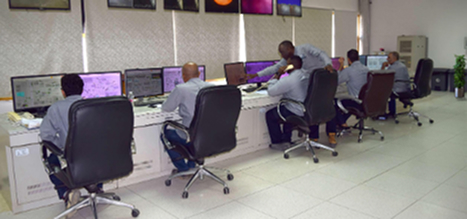
The digital transformation program at UCIC has delivered a manufacturing environment where operational data flows in real time to support process decisions, where administrative and commercial workflows are automated to reduce manual processing time and error rates, and where management visibility into plant performance is continuous rather than periodic. This infrastructure raises operational efficiency, reduces waste in both energy and materials consumption, and provides the data foundation required for the predictive maintenance and process optimization programs that deliver the next tier of performance improvement.

UCIC’s digital journey also demonstrates the compounding relationship between digital capability and sustainability outcomes. A plant with accurate, real-time energy consumption data can optimize combustion parameters more precisely. A plant with predictive maintenance intelligence reduces unplanned stoppages that generate energy waste and quality variance during restart cycles. Digital capability and environmental performance are not parallel tracks. At UCIC, they are the same track.

Operational Excellence

Energy, Maintenance, and Circular Economy

UCIC has achieved leading performance on specific electrical energy consumption for its product range, positioning itself among the most energy-efficient cement producers in the western region. This performance reflects the deployment of advanced kiln and grinding system technologies, combined with the operational discipline that comes from a relatively young plant managed with modern industrial standards from the outset.

The maintenance strategy deployed at UCIC has delivered a meaningful reduction in unplanned stoppages and improved production continuity. Advanced maintenance approaches, supported by condition monitoring and predictive analytics, have lowered failure rates, extended equipment service life, and reduced the cost and production impact of maintenance interventions. The result is a more reliable and predictable production operation, which benefits both cost efficiency and the consistency of product quality delivered to customers.

The circular economy principles applied within UCIC’s operations extend the sustainability logic beyond emissions reduction to resource utilization. Where industrial by-products can be reintegrated into the production process, the company pursues those pathways, converting potential waste streams into productive inputs. This approach simultaneously reduces raw material demand, lowers disposal costs, and improves the overall resource efficiency of the plant.

Saudization and Local Content

Sustained Platinum Performance

UCIC has maintained Platinum tier classification under the Nitaqat Saudization program since its establishment, a record of sustained commitment to national workforce development that is particularly noteworthy given the company’s young operational age. Maintaining Platinum status from the outset, rather than achieving it after years of incremental improvement, reflects an organizational design decision that embedded localization as a foundational principle rather than a compliance target.

Local procurement has exceeded 80 percent of total purchases, reinforcing the domestic supply chain and contributing to the national economy’s industrial development objectives. This level of local content is above the sector average and reflects deliberate supply chain management decisions that favor domestic suppliers where quality and delivery standards are met.

The combination of Platinum Saudization and high local content positions UCIC as a company whose contribution to Vision 2030’s economic diversification and human capital development objectives extends well beyond its product range. The western region’s cement market is one of the most strategically important in the Kingdom, serving Jeddah, Makkah, and the entire Hajj and Umrah infrastructure. UCIC’s investment in national talent and domestic supply chains strengthens the economic resilience of that market.

Strategic Position

The Golden Years Ahead

UCIC’s CEO Mohammed Almatrafi has articulated a clear demand outlook: the period ahead represents the “golden years” for the Saudi cement sector. The 2034 FIFA World Cup, Expo 2030, Central Jeddah development, the Red Sea Project, NEOM, and Qiddiya are all driving sustained construction demand in the regions that UCIC serves. With a market share of 18 to 20 percent in the western region, a product portfolio already heavily weighted toward green cement, a certified digital maturity framework, and a solar energy program underway, UCIC is positioned to capitalize on that demand from a platform of operational and environmental leadership.

From FCI’s perspective, what UCIC demonstrates is that a well-designed industrial strategy, executed consistently from the first day of operations, can compress the transformation timeline significantly. UCIC did not spend its first decade operating a conventional cement plant and then launch a sustainability program. It launched with a sustainability orientation built into its production model and has been refining and extending that model ever since.

The result is a company that is, by several meaningful measures, among the most advanced green cement producers in the Kingdom today, and one that is investing systematically in the capabilities that will sustain that position as the market’s expectations continue to rise.