
The Weight of Being First
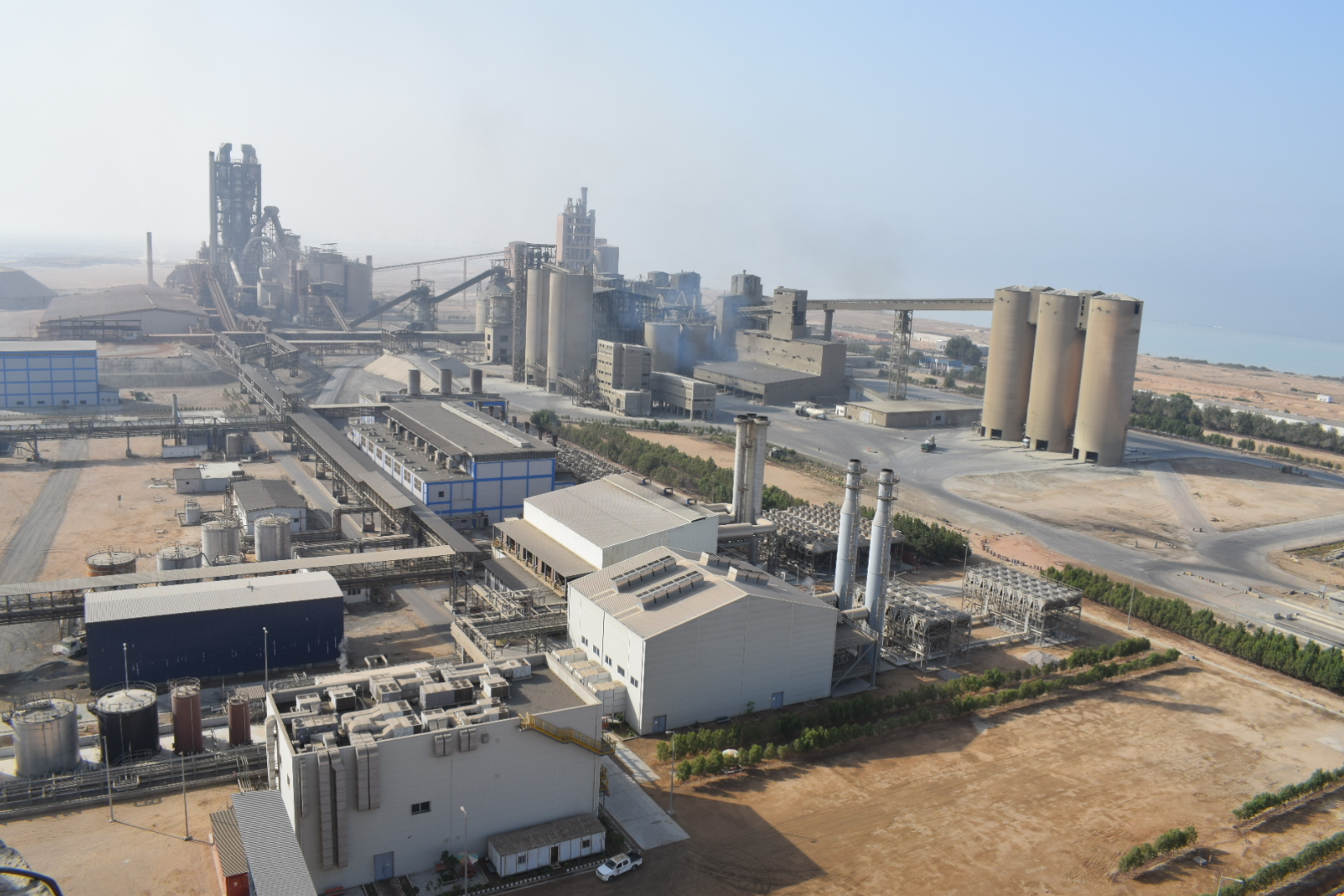
Arabian Cement Company carries a distinction that no other producer in Saudi Arabia or the broader Gulf region can claim. It was the first cement company established in the Kingdom, founded in Jeddah in 1957 under the patronage of King Saud bin Abdulaziz. Over 71 years of continuous industrial operation, ACC has expanded from a 2,000 ton per day clinker facility to a plant at Rabigh capable of producing 12,200 tons of clinker per day across two modern production lines. It has survived market cycles, regulatory transitions, and structural shifts in the competitive landscape. That institutional resilience is the starting point for understanding what ACC is now attempting: a structured, phased transformation toward a fundamentally different production model, one that is lower in carbon intensity, more digitally intelligent, and more operationally disciplined than anything the company has operated before.
The transformation is not framed as a response to external pressure. It is framed as a strategic choice, grounded in four interconnected pillars: sustainability, decarbonization, operational excellence, and digital transformation. Each pillar has its own logic, but the company’s position is that they are mutually reinforcing. Decarbonization without operational excellence is inefficient. Digital transformation without a sustainability target lacks direction. The four pillars only deliver their full value when they are pursued together, and ACC’s 2026 to 2030 roadmap is built on exactly that premise.
Starting From a Clear Baseline
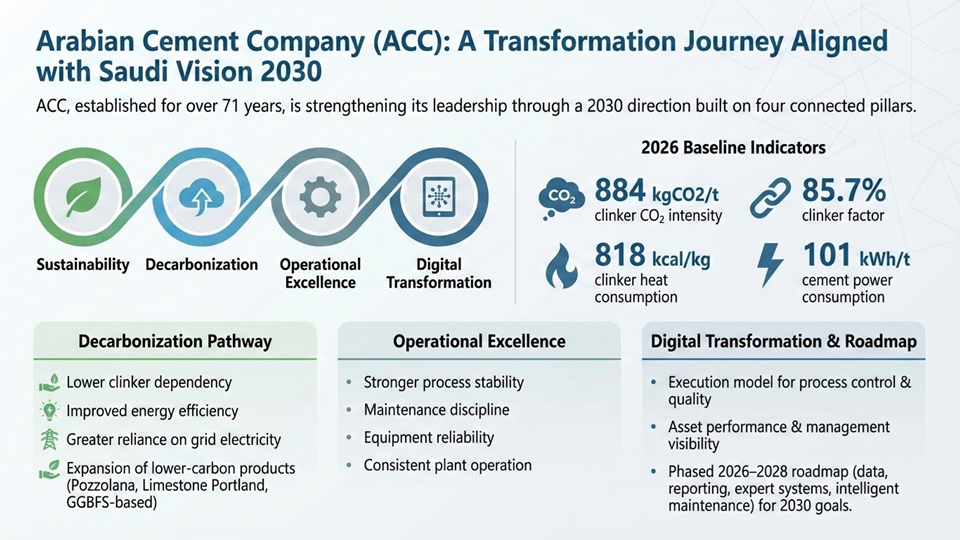
One of the more disciplined aspects of ACC’s transformation approach is the commitment to starting from a documented, specific baseline rather than from aspirational language. The company’s 2026 indicators provide the quantified starting point against which all future progress will be measured.
ACC’s current CO2 intensity stands at 884 kg CO2 per ton of clinker, with a clinker factor of 85.7 percent. Thermal energy consumption is 818 kcal per kg of clinker, and electrical energy consumption for cement production is 101 kWh per ton. These numbers define the challenge precisely. They tell the company and its stakeholders exactly where performance stands today, what the gap to best-in-class looks like, and which levers carry the most decarbonization potential.
The clinker factor is particularly significant. At 85.7 percent, it represents the share of clinker in the final cement product. Every percentage point of clinker replaced with lower-carbon supplementary materials reduces both the thermal energy demand and the process CO2 intensity of the product. This makes clinker factor reduction the single highest-leverage variable in ACC’s decarbonization equation, and it is central to the company’s stated pathway forward.
The Decarbonization Pathway
Four Levers, One Direction
ACC’s decarbonization strategy is built on four connected levers. The first is reducing clinker dependency through a deliberate shift in product mix toward lower-carbon cement types. Portland Pozzolana Cement, Limestone Portland Cement, and GGBFS-based products are all positioned as core to the company’s future portfolio, each offering a meaningful reduction in clinker-to-cement ratio while meeting the performance requirements of the Saudi construction market.
The second lever is improved energy efficiency across the thermal and electrical dimensions of production. With heat consumption at 818 kcal per kg of clinker and electrical consumption at 101 kWh per ton of cement, there is defined headroom for improvement. The process expert systems and energy reporting tools in the digital roadmap are specifically designed to surface the efficiency opportunities that exist within current operations.
The third lever is a strategic shift toward greater reliance on grid electricity. As Saudi Arabia’s grid continues to incorporate larger shares of renewable generation, a cement producer with higher grid dependency and lower captive fossil fuel generation will carry a structurally lower Scope 2 emissions profile. ACC’s direction of travel on this dimension aligns with the Kingdom’s broader energy transition trajectory.
The fourth lever is the expansion of the lower-carbon product portfolio described above, which addresses both the clinker factor and the product-level carbon intensity simultaneously. Taken together, these four levers constitute a coherent decarbonization pathway, not a collection of standalone projects.
The Digital Roadmap
Infrastructure for Execution
ACC has described digital transformation explicitly as the practical execution model for its sustainability and decarbonization goals. This framing is important. It positions digital investment not as a technology objective in itself, but as the operational infrastructure required to achieve the performance targets that the transformation agenda demands.
The 2026 to 2028 digital roadmap is structured and phased. It covers six capability domains: plant data management, energy reporting, process expert systems, dispatch optimization, intelligent maintenance, and management reporting tools. Each domain addresses a specific performance gap identified in the current operating model.
Plant data management creates the data foundation on which everything else depends. Without clean, consistent, and accessible plant data, neither energy reporting nor process optimization can deliver their intended value. Energy reporting tools provide the visibility required to track consumption against targets in real time, enabling faster intervention when performance deviates from plan. Process expert systems bring the kind of model-based optimization to kiln and mill operations that consistently deliver reductions in specific energy consumption and emissions intensity across the plants that have deployed them.
Dispatch optimization addresses logistics efficiency, reducing the idle time, excess fuel consumption, and delivery unreliability that characterize less optimized cement distribution operations. Intelligent maintenance moves the plant from scheduled and reactive maintenance toward predictive approaches that extend equipment life, reduce unplanned downtime, and lower maintenance cost per ton. Management reporting tools close the loop by ensuring that operational data reaches decision-makers in a form they can act on, rather than remaining trapped in plant-level systems.
The SIRI assessment conducted in 2023 provides an independent external baseline for ACC’s digital maturity. The assessment placed the company with zero dimensions in the bottom performers range, 10 in the broad middle range, and 6 at best-in-class level globally. Shop Floor Connectivity and Facility Connectivity both achieved Band 5 (Scalable), the highest possible rating, reflecting the strength of ACC’s plant automation and real-time communication infrastructure. The priority dimensions identified for further development were Vertical Integration, Shop Floor Intelligence, and Leadership Competency, which map precisely onto the capability gaps that the 2026 to 2028 digital roadmap is designed to close.
Operational Excellence
The Performance Foundation
ACC is explicit that operational excellence is not a consequence of digital transformation. It is a precondition for it. Process stability, maintenance discipline, equipment reliability, and consistent plant operation are the foundation on which digital systems deliver their intended value. A plant with unstable process conditions, frequent unplanned stoppages, and inconsistent product quality will not benefit from expert system deployment until the underlying operational fundamentals are addressed.
This sequencing reflects an experienced operational judgment. ACC has operated at industrial scale for over seven decades. The understanding that technology adoption requires a stable operational base is not a theoretical position. It is a practical lesson drawn from long experience in cement manufacturing. The transformation roadmap builds on this understanding by positioning operational excellence improvements alongside, and in some cases ahead of, the digital deployments that follow.
The Rabigh plant’s highly automated production infrastructure, with full DCS control from raw material reclaiming through to finished product dispatch and Oracle OPM integration across all enterprise functions, provides the operational platform on which the next phase of transformation will be built. The delivery performance of 30 minutes from truck-in to truck-out for professional customers reflects the operational efficiency already embedded in the plant’s logistics model.
Governance and ESG Reporting
The Institutional Backbone
ACC’s sustainability transformation is supported by a governance framework that is among the most rigorous in the Saudi industrial sector. The company has published its third annual GRI-aligned ESG report, covering performance against Global Reporting Initiative Core standards and all 17 United Nations Sustainable Development Goals. Its nine-member Board of Directors achieves 56 percent independence, with all committees reporting 100 percent attendance in 2024. The Corporate Governance Excellence Award has been received for five consecutive years from 2019 through 2023, evaluated against more than 200 listed companies on the Saudi Stock Exchange.
The Saudization rate of 54 percent, classified within the Platinum tier of the Nitaqat program, reflects the company’s commitment to national workforce development. Employee satisfaction stands at 88.84 percent, and training investment reached SAR 925,000 in 2024 across 200 training hours. Local procurement reached 78 percent of total purchases in 2024, up from 72 percent in 2023, reinforcing the company’s contribution to the domestic economy.
The transparency standard ACC holds itself to includes disclosure of compliance gaps as well as achievements. The four environmental permit violations received in 2024 due to delayed renewal submissions are disclosed fully in the ESG report, along with the corrective actions taken. This level of transparency, disclosing what went wrong as clearly as what went right, is precisely the credibility standard that makes ESG reporting meaningful to external stakeholders.
What This Transformation Signals for the Sector
ACC enters its transformation journey from a position of institutional strength. It owns its raw material resources across limestone, clay, gypsum, pozzolan, and iron ore. It operates a highly automated, fully DCS-controlled production facility. It has a governance structure capable of holding leadership accountable to long-term commitments. And it now has a documented baseline, a defined roadmap, and a clear set of performance targets against which progress can be tracked.
From FCI’s perspective, ACC’s approach reflects something the sector needs more of: a transformation agenda grounded in operational reality rather than aspirational positioning. The baseline KPIs are specific. The roadmap is phased and sequenced. The four strategic pillars are genuinely connected rather than loosely parallel. And the decarbonization levers, clinker factor reduction, energy efficiency, grid shift, and lower-carbon product expansion, address the real sources of cement’s carbon footprint rather than peripheral variables.
The Kingdom’s oldest cement company is making a deliberate choice to be among the ones that define what comes next. At 71 years of operation, that choice carries weight.