
The Starting Point
A Different Kind of Question
Most sustainability narratives in the cement industry begin with a target: a carbon reduction percentage, a renewable energy commitment, a net-zero horizon year. Yamama Cement Company’s story begins with a more fundamental question, one that is harder to answer and more consequential when answered well. The question is not simply how much to reduce, but how to embed sustainability so deeply into the operating model that efficiency and environmental performance become the same thing.
That question has guided Yamama’s transformation over recent years, producing results that are measurable, structural, and increasingly difficult for competitors to replicate quickly. The company has built a case study in integrated industrial change: one where product innovation, digital intelligence, energy management, and human capital development are not parallel workstreams but a single, coherent direction of travel.
GREEN PLC
Turning Product Strategy into a Carbon Statement
 The most visible expression of Yamama’s sustainability commitment is the development and commercialization of its GREEN PLC product line, a lower-carbon cement engineered to reduce the carbon footprint per ton of cement produced. The company has targeted a carbon intensity of below 650 kilograms of CO2 per ton, a threshold that positions GREEN PLC meaningfully below the carbon profile of conventional Portland cement production in the Kingdom.
This is not a niche product or a pilot offering. It is a strategic repositioning of Yamama’s product portfolio toward the low-carbon building materials market that Saudi Arabia’s construction pipeline, driven by Vision 2030’s giga-projects and urban development programs, will increasingly demand. The decision to develop GREEN PLC reflects a clear-eyed reading of where the market is heading and a commitment to leading that transition rather than responding to it.
What makes this product decision strategically significant is that it forces upstream discipline. Delivering a consistently lower-carbon cement at commercial scale requires tighter control over clinker quality, mix design, and production process stability. The product, in other words, pulls the entire operation toward higher standards. It does not sit separately from operational excellence. It demands it.
Digital Transformation
From Data Collection to Decision Intelligence
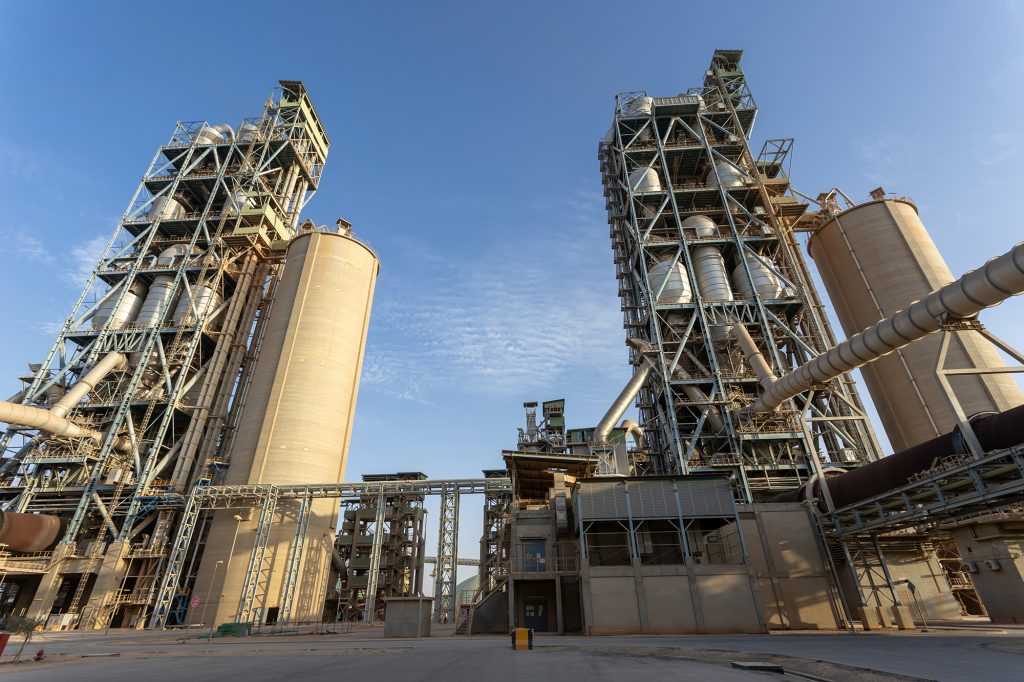
Yamama’s operational transformation is anchored in a comprehensive digital upgrade that has materially changed how the plant operates, monitors its assets, and makes decisions. The shift is from a reactive and planned maintenance culture toward a predictive, data-driven operating environment, where equipment health is continuously monitored and potential failures are identified before they generate downtime.
The company deployed AI and IoT-based predictive maintenance technology across its cement mills and critical rotating equipment, installing wireless vibration and ultrasonic sensors that feed continuous condition data into cloud-based AI analytics platforms. The outcome is a 48 percent increase in the number of assets under active digital monitoring, a 15 percent reduction in unplanned downtime, and a threefold improvement in the accuracy and timeliness of fault prediction.
The practical significance of these numbers is substantial. In a cement plant operating at scale, an unplanned stoppage of a mill or kiln drive does not just affect output for that shift. It triggers a cascade of scheduling disruptions, energy waste during restart cycles, and quality variation that takes time to stabilize. Reducing the frequency and duration of such events through predictive intelligence creates compounding value: more consistent production, lower maintenance cost per ton, and a more predictable cost base overall.
The implementation approach is also instructive. Yamama chose a wireless, cloud-based architecture that allowed deployment in 15 days, without major shutdowns, hot work, or integration into core IT systems. This kept security exposure low and allowed the reliability team to expand their monitoring program to a significantly larger asset base without proportional increases in headcount. It is a pragmatic model for scalable digital transformation in an operating plant environment.
Beyond maintenance, the digital transformation has accelerated decision-making across the operational layer. Real-time data access has reduced response time to operational anomalies, simplified control room operations, and created a continuous improvement feedback loop that management can act on immediately rather than in the next planning cycle.
Energy Efficiency
The Compounding Impact of Systematic Improvement
Energy management at Yamama is not treated as a standalone cost reduction program. It is positioned as a core operational discipline with direct implications for both financial performance and carbon intensity. The company has pursued a systematic efficiency improvement program across its production operations, targeting the specific energy consumers that account for the largest share of total consumption.
The results reflect the cumulative effect of multiple coordinated interventions rather than any single project. Electrical energy consumption for cement production has been reduced by approximately 15 percent, a reduction that, at Yamama’s production scale of 6 million tons of clinker capacity annually, translates into a significant absolute reduction in energy cost and associated emissions.
The energy efficiency program is directly linked to the digital transformation described above. Assets operating with bearing faults, poor lubrication, or mechanical imbalance consume disproportionate energy before they fail. The predictive maintenance program, by catching these conditions early, reduces energy waste as a secondary benefit. This is the kind of system-level linkage that distinguishes a genuinely integrated transformation from a collection of separate initiatives.
Saudization and Human Capital
Building the Workforce the Sector Needs
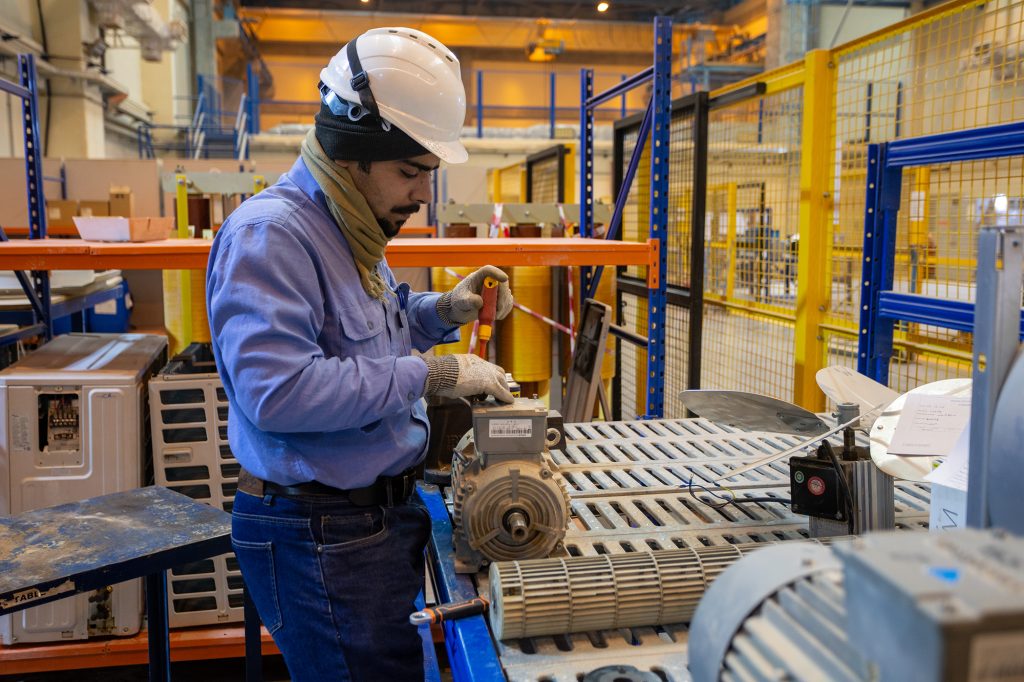
Yamama’s transformation agenda extends beyond equipment and processes. The company has made a deliberate investment in building Saudi national capability across its technical and managerial workforce, with a Saudization rate of 75 percent of total employment. This figure reflects not just regulatory compliance but a considered strategic investment in the human infrastructure required to sustain long-term operational excellence.
This matters for the sector as a whole. The cement industry’s transition to digital operations, lower-carbon products, and continuous improvement cultures requires a workforce that can manage complex systems, interpret data, and drive change from within the organization. Yamama’s investment in national talent development is building exactly that capability, and doing so in a context where the technical roles being filled are more demanding than the generation before them.
The company’s leadership has been explicit about this connection. Automation and digitization are not positioned as replacements for skilled people. They are positioned as tools that elevate what skilled people can accomplish. That framing shapes how training, career development, and operational responsibility are structured within the company.
The Larger Significance
A Model Built to Scale
From FCI’s perspective, what Yamama Cement has built is not just a successful plant-level transformation. It is a replicable model for how a regional cement producer navigates the transition to a more sustainable and competitive industrial position.
The model has three defining characteristics. First, it is integrated: product innovation, digital capability, energy efficiency, and workforce development are connected and mutually reinforcing rather than siloed programs competing for budget and attention. Second, it is evidence-based: every initiative is tracked against specific performance indicators, and the results are transparent enough to inform decisions about where to invest next. Third, it is scaled to commercial reality: Yamama is not a pilot project or a greenfield facility. It is a large-scale, multi-decade operating company that has transformed itself from within.
The cement sector in Saudi Arabia and across the region is at a point where the gap between companies that have made this transition and those that have not will begin to widen materially, both in cost competitiveness and in access to markets that are increasingly requiring documented carbon performance from their supply chains. Yamama Cement’s trajectory positions it well on both dimensions.
The journey is not complete. No industrial transformation of this scope ever is. But the direction is clear, the results are real, and the model is one that the sector can learn from.